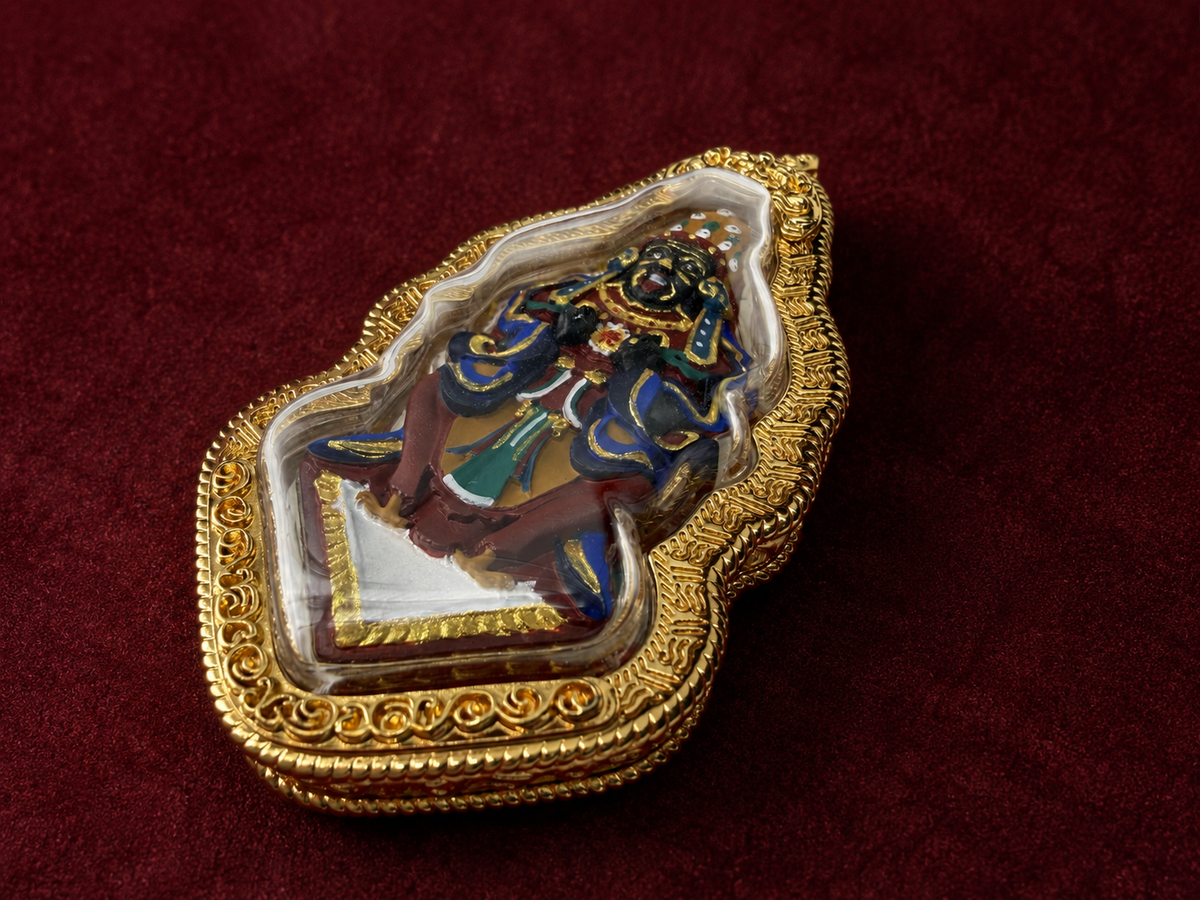
ABSTRACT / DIRECT ANSWER
A tsa-tsa—Tibetan ཚ་ཚ་, commonly transliterated tsha tsha, tsa-tsa, or tsatsa—is a small Buddhist image produced through a mold, most often in clay. It may depict a Buddha or deity, a teacher, a stupa, a mantra, or another sacred form. Tsa-tsas could be made in quantity, yet quantity did not make them culturally insignificant: they were used in merit-making, pilgrimage, household shrines, portable devotional settings, sacred sites, and as deposits within stupas and larger images. Their history connects Tibetan practice with older South Asian traditions of molded Buddhist votive objects.
Their importance lies precisely in a combination that can look paradoxical from a modern art-market perspective: small scale, inexpensive material, and reproducibility could make a sacred image more—not less—effective as a vehicle of devotion, circulation, and visual transmission.
1. What Is a Tsa-Tsa?
The simplest technical definition is a small molded Buddhist image.
Chandra L. Reedy describes Tibetan tsha-tshas as devotional clay objects made by stamping wet clay or pressing it into wooden or metal molds. They may depict deities, religious teachers, shrines, inscriptions, sacred syllables, or longer mantras. Some are sun-dried; others were fired at relatively low temperatures; paint may or may not be added afterward.
That definition already explains why the category is broader than “miniature Buddha statue.”
A tsa-tsa can be:
- a shallow relief plaque;
- a deeply molded figure;
- a small stupa in the round;
- an inscribed devotional tablet;
- an image intended for a personal shrine;
- a consecratory deposit placed inside another sacred object.
Project Himalayan Art similarly defines a tsa-tsa as a small image created by pressing clay into a mold and notes subjects ranging from deities and stupas to auspicious signs.
The category is therefore defined less by one iconographic subject than by a relationship between image, mold, material, replication, and religious use.
2. Where Does the Term Tsha-Tsha Come From?
The term is familiar; its etymology is less settled.
Several explanations have been proposed, and the evidence does not justify presenting one as universally proven.
A translation resource from 84000 glosses a related Tibetan form in relation to Sanskrit sāñcaka, referring to a molded image—small clay images of caityas, deities, and related forms—and notes that Tibetan tsha tsha is the more common form.
Daniel Berounský and Lubomír Sklenka, however, review an older philological debate in their study Tibetan Tsha-Tsha. They discuss the proposed connection with Sanskrit sañcaka, “mold” or “stamp,” but favour a different derivation through forms related to saccha / sat-chāya, interpreted in earlier scholarship as “excellent,” “perfect,” or a reproductive image. Their article makes clear that the word’s history has been debated rather than simply solved.
Documented fact: tsha tsha is the established Tibetan term for these molded devotional forms.
Scholarly interpretation: Sanskrit or Middle Indo-Aryan terms related to molding, stamping, copying, or the notion of an image have been proposed as its linguistic ancestry.
Open question: the exact path from Indic terminology to the Tibetan form cannot be reduced responsibly to one uncontested etymology.
The uncertainty reflects the wider history of an object that moved through linguistic and cultural worlds alongside Buddhist technologies and images.
3. Before Tibet: Moulded Buddhist Votive Images in India
Tibetan tsa-tsas did not emerge in a vacuum.
Small molded Buddhist images had a long history in South Asia, especially around pilgrimage centres. Bodh Gaya—the site associated with the Buddha’s awakening—is particularly important.
A ninth-century terracotta plaque now in the British Museum, 1887,0717.81, was found at Bodh Gaya. It measures 15.3 × 11 × 3.3 cm and was made by molding terracotta. The central image shows the Buddha in the earth-touching gesture seated inside a representation of the Mahabodhi Temple. Small stupas surround the shrine, while a three-line inscription below contains the Buddhist formula of dependent origination. The British Museum notes that the presentation and enshrinement of such plaques were regarded as meritorious acts.
This object is not itself a Tibetan tsa-tsa. It is valuable as comparative evidence for an older South Asian tradition in which sacred imagery, text, mold technology, pilgrimage, and merit-making were already closely connected.
The same underlying logic appears repeatedly:
- 1. a sacred image is encoded in a reusable matrix;
- 2. the image can be produced repeatedly;
- 3. inscriptions may accompany the image;
- 4. production and offering can be linked with merit;
- 5. objects can circulate around sacred sites or be enshrined.
Research on Tibetan ritual literature strengthens the case for Indic connections. Saerji’s study of a Tibetan tantric ritual folio discusses procedures for making clay tablets (tsha tsha) and investigates their Indian ritual background and transmission into Tibetan textual traditions.
This supports historical continuity at the level of ritual technologies and textual transmission, but not a simplistic claim that one specific Bodh Gaya plaque directly “became” the later Tibetan tsa-tsa.
4. Early Tsa-Tsas in Tibet
By the tenth and eleventh centuries, molded clay objects are securely documented in Tibetan contexts.
The Metropolitan Museum of Art’s 2011.43, dated to the tenth–eleventh century, is an especially useful example. Made in Tibet from sun-dried and painted clay, it measures 10.5 × 6.7 × 3.5 cm. The object depicts a stepped stupa crowned by umbrellas and banners. Around it appears the ye dharma formula—the verse of dependent origination, Sanskrit pratītyasamutpādagāthā. The Met notes that the stupa type itself reflects an early north Indian architectural form.
The object compresses architecture, doctrine, and portable clay technology into one small form.
At roughly the same historical horizon, western Tibet became an especially important centre for tsa-tsa production. Kunsang Namgyal-Lama’s study of an eleventh–twelfth-century Amoghapasha tsa-tsa from Guge argues that Indian and Kashmiri Buddhist masters and artistic currents played a major role in western Tibetan image-making during the later diffusion of Buddhism. She notes that molds might be imported or created locally, and that inscriptions could even be added or modified after the original matrix had been made.
Here the mold is more than a production tool. It can carry iconography, inscriptions, stylistic features, and evidence of cross-regional artistic contact. A single matrix could transmit these features repeatedly.
5. Why Were Tsa-Tsas Reproduced in Moulds?
Modern collecting culture often places great value on uniqueness: one artist, one original, one irreplaceable object.
Tsa-tsas emerged from a different system of value.
Kunsang Namgyal-Lama characterises serial production itself as part of Buddhist ritual practice. Her research describes molded tsa-tsas as images deliberately made in series, with their production connected to merit-making and consecratory procedures. Project Himalayan Art likewise notes that molded clay plaques could be produced in quantity and deposited in stupas in merit-making contexts.
Reedy identifies a wider range of functions. Tsa-tsas could serve as consecrated deposits inside statues or stupas, affordable religious images for ordinary households, portable images for mobile users, pilgrimage souvenirs, memorial objects, or sets preserving correct deity iconography. The act of making them could itself become devotional practice.
Repetition, then, was not necessarily a defect.
It allowed an image to become numerous without becoming iconographically random; portable without requiring large sculpture; affordable without losing religious function; and repeatable while remaining capable of receiving a particular ritual, dedication, location, or personal history.
The “original” was often the mold—or, at another level, the authoritative iconographic pattern behind it. Each impression could then acquire a separate biography.
6. Where Were Tsa-Tsas Used?
No single use defines the tradition.
Pilgrimage
The Met’s 38.80.5, a Tibetan clay tsa-tsa of Thousand-Armed Avalokiteshvara dated approximately sixteenth–eighteenth century, measures only 6.3 × 4.1 cm. The museum describes such plaques as being produced at sacred centres and carried home by pilgrims, either for veneration in household shrines or as offerings at temples and sacred places.
A tsa-tsa could therefore function as a portable material connection with a pilgrimage site.
Household shrines
Reedy notes that inexpensive molded images made Buddhist imagery accessible to people for whom large paintings or metal sculptures might be impractical or unaffordable. Their small size suited domestic altars and intimate devotional settings.
Portable shrines
Reedy also records their use in portable amulet cases and ga’u shrines, especially relevant in communities where mobility formed part of everyday life.
Stupa and image deposits
Some tsa-tsas were sealed within stupas, statues, or other sacred structures as consecratory contents. Namgyal-Lama emphasises that tsa-tsas could themselves become sacred deposits within other Buddhist receptacles.
Sacred sites and funerary contexts
Other examples were left at sacred locations, associated with deceased persons, or made with particular substances linked to funerary practice. These uses are historically documented, but they do not apply automatically to every tsa-tsa.
The same basic technology could therefore serve markedly different religious and social purposes.
7. Four Objects Across More Than a Thousand Years
| Object | Date / Region | Material & Form | Text / Image | Context |
|---|---|---|---|---|
| British Museum 1887,0717.81 | 9th c., Eastern India; found at Bodh Gaya | Moulded terracotta plaque, 15.3 × 11 × 3.3 cm | Buddha in Mahabodhi Temple; stupas; dependent-origination inscription | Presentation and enshrinement understood as meritorious |
| The Met 2011.43 | 10th–11th c., Tibet | Sun-dried painted clay, 10.5 × 6.7 × 3.5 cm | Stupa + ye dharma creed | Early Tibetan appropriation of Indic Buddhist architectural and textual forms |
| The Met 38.80.5 | ca. 16th–18th c., Tibet | Clay plaque, 6.3 × 4.1 cm | Thousand-Armed Avalokiteshvara | Pilgrimage, household shrine, temple or sacred-site circulation |
| British Museum 2000,1220.3 | 20th c., Tibet | Moulded terracotta, 9 × 7 × 2.5 cm | Prajnaparamita; barley seeds embedded at back | Modern impression made from a mold dated approximately to the 18th century |
What remained stable?
All four objects depend on repeatable image technology. All compress a larger Buddhist visual or textual world into a small, portable format. None requires monumental scale to carry religious meaning.
What changed?
Material treatment changed. The Bodh Gaya plaque is terracotta; the early Tibetan stupa plaque is explicitly sun-dried and painted clay. “Clay votive object” does not imply one identical firing or drying technology.
Subject changed. A sacred pilgrimage monument, an abstracted stupa, a highly complex bodhisattva, and Prajnaparamita can all occupy the same broad technological category.
Scale changed. The Bodh Gaya plaque is substantially larger than the later pilgrimage-sized Avalokiteshvara plaque.
Use changed—or multiplied. Meritorious enshrinement, doctrinal inscription, portable pilgrimage image, household devotion, sacred-site offering, and later ritual adaptation all appear.
The relationship between mold date and object date also changed. British Museum 2000,1220.3 is a twentieth-century impression made from a mold dated approximately to the eighteenth century. The age of a visual design, the age of a mold, and the age of an individual clay impression are not necessarily the same thing.
8. What Changed—and What Stayed the Same?
The tsa-tsa tradition was not geographically or technically static.
Research by Guo Meng and Zhang Jianlin on material excavated from the northern area of the Mogao Caves at Dunhuang identified both molded stupa types and molded Buddha-image types. By comparing them with Tibetan, Tangut, and Central Plains Buddhist clay traditions, the authors propose that the Dunhuang group reflects the northward diffusion of Tibetan Buddhist art. The excavated objects are archaeological evidence; the proposed direction of artistic diffusion is the authors’ scholarly interpretation.
Regional comparison also warns against collapsing every Asian molded Buddhist clay image into the Tibetan category tsha tsha. India had its own long history of Buddhist votive tablets. Central China developed traditions often discussed under terms such as “virtuous-karma clay” (shanyeni / 善業泥). Tangut and Tibetan communities produced related but not identical material.
The technologies overlap because Buddhist ritual and image culture travelled. The categories do not become identical merely because all used molds.
What remained remarkably persistent was the attraction of a compact matrix-based object that could unite image, text, repetition, dedication, movement, and ritual use.
9. Why Small, Reproducible Objects Matter in Buddhist Art History
Large bronzes and monumental paintings dominate museum displays because they are visually impressive. Tsa-tsas preserve a different history: they show how Buddhist imagery moved at ordinary scale.
The Met’s pilgrimage tsa-tsas demonstrate that small molded images circulated between sacred centres and local communities. Namgyal-Lama’s western Tibetan material goes further: an eleventh–twelfth-century Amoghapasha tsa-tsa preserves Indian and Kashmiri stylistic features at the scale of a hand-held clay object. Molds could therefore carry artistic style as well as religious identity.
Reedy notes another role: collections of tsa-tsas could function as iconographic reference sets, helping preserve correct deity forms.
- From an art-historical perspective, repetition is therefore evidence. Repeated images can reveal which iconographic forms circulated widely; which inscriptions accompanied them; how sacred sites reproduced themselves visually; how stylistic traditions travelled; where molds were reused; and how identical matrices produced objects with different later histories.
A unique bronze can tell us about one exceptional commission. A group of related tsa-tsas may reveal an entire network of reproduction and circulation.
For a collector, the question is not always “Is this the only one?” It may be: “What matrix produced it, where did that matrix circulate, what changed between impressions, and what happened to this particular object afterward?”
10. How Were They Made?
There was no single universal process.
Reedy documents wet clay being stamped or pressed into wooden or metal molds, then sun-dried or sometimes fired at low temperatures. Paint was often, but not always, added. Project Himalayan Art emphasises molded clay production and notes the widespread use of metal molds. In western Tibet, Namgyal-Lama also records the possibility that molds were either brought from India or made locally.
A cautious general sequence is:
prepare clay → press or stamp in a mold → release the form → dry or otherwise finish the body → add paint or other treatment where appropriate → use, consecrate, deposit, carry, or enshrine according to context.
That outline describes documented possibilities, not a universal recipe.
For a detailed study of mold types, forming, drying, firing, painting, and modern production boundaries, see How Tibetan Tsa-Tsas Are Made: From Clay to Hand-Finished Object.
11. Tsa-Tsas Today
Tsa-tsa making did not end with the historical objects now preserved in museums. Contemporary Tibetan and Himalayan communities continue to make molded devotional images, while individual workshops and commercial contexts use different techniques, materials, finishing methods, and ritual processes.
At TIBETAN SHAMBHALA, current tsa-tsa objects are described according to their own verified production records rather than by projecting one historical method onto every contemporary piece.
Related Objects
Readers who want to examine contemporary examples at close scale may explore:
- CS Series — /collections/cs-curated-selection
- ES Series — /collections/es-entry-collection
- confirmed tsa-tsa works in the HC Heritage Collection
These collections are contemporary objects connected to a much longer visual tradition; they do not imply that all historical tsa-tsas were produced in the same way.
12. What We Can Say with Confidence
- Molded Buddhist votive plaques existed in India before the mature Tibetan tsa-tsa tradition.
- Tibetan molded clay tsa-tsas are securely documented by the tenth–eleventh century.
- Tsa-tsas could depict stupas, deities, teachers, inscriptions, and other sacred subjects.
- Their documented uses include merit-making, shrine use, pilgrimage, sacred-site offering, portable devotion, memorial contexts, and consecratory deposits.
- Molds made repetition possible, and repeated production itself could be part of Buddhist devotional practice.
- A surviving impression can be much younger than the mold used to produce it.
13. What Remains Variable or Uncertain
- The precise linguistic origin of tsha tsha remains debated.
- Not every tsa-tsa was made from the same clay mixture.
- Not every example was sun-dried; some were fired.
- Not every example was painted.
- Not every tsa-tsa contained medicines, ashes, grain, or other inserted material.
- Not every tsa-tsa was made for pilgrimage.
- Not every tsa-tsa underwent the same consecration procedure.
- A deity shown on a tsa-tsa does not by itself establish that object’s original ritual use.
- Mold age, image-design age, and impression age must be distinguished when evidence permits.
Tsa-tsa histories vary too widely to treat every object as part of one standard process.
Related Reading
How Tibetan Tsa-Tsas Are Made: From Clay to Hand-Finished Object
/blogs/journal/how-tibetan-tsa-tsas-are-made
References / Source Notes
Berounský, Daniel, and Lubomír Sklenka. “Tibetan Tsha-Tsha.” Annals of the Náprstek Museum 26(1), 2005, pp. 59–72.
https://publikace.nm.cz/en/periodicals/annals-of-the-naprstek-museum/26-1/tibetan-tsha-tsha
Reedy, Chandra L. “Multiple Functions and Multiple Histories of Tibetan Tsha-Tshas (Votive Clay Images).” Studies in Conservation 51, Supplement 2, 2006, pp. 144–150. DOI 10.1179/sic.2006.51.Supplement-2.144.
https://www.tandfonline.com/doi/abs/10.1179/sic.2006.51.Supplement-2.144
Namgyal-Lama, Kunsang. “Du sacré produit en masse : les tsha tsha du monde tibétain.” Histoire de l’art 73, 2013, pp. 97–104. DOI 10.3406/hista.2013.3472.
https://www.persee.fr/doc/hista_0992-2059_2013_num_73_1_3472
Namgyal-Lama, Kunsang. “Tsha tsha Inscriptions: A Preliminary Survey.” In Tibetan Inscriptions, Brill’s Tibetan Studies Library 32, 2013, pp. 1–41.
https://brill.com/display/book/9789004252417/B9789004252417-s002.xml
Namgyal-Lama, Kunsang. “Molded Clay Image (Tsatsa) of Amoghapasha: Mass Production of Images as a Ritual Practice.” Project Himalayan Art, Rubin Museum of Himalayan Art, 2023.
https://rubinmuseum.org/projecthimalayanart/essays/molded-clay-image-tsatsa-of-amoghapasha/
Saerji. “A Preliminary Study on One Folio of Tibetan Tantric Ritual Text Recently Collected by the National Library of China.” Studies in Chinese Religions 7(2–3), pp. 236–244. DOI 10.1080/23729988.2021.1942522.
https://www.tandfonline.com/doi/full/10.1080/23729988.2021.1942522
Guo Meng 郭萌 and Zhang Jianlin 張建林. “敦煌莫高窟北區出土擦擦研究 / The Study on the Tsha-tsha Unearthed at the North Zone of the Dunhuang Caves.” 文博 / Relics and Museology, no. 5, 2015, pp. 34–41.
https://buddhism.lib.ntu.edu.tw/en/search/search_detail.jsp?seq=589104
British Museum, object 1887,0717.81. Ninth-century Eastern Indian molded terracotta plaque from Bodh Gaya.
https://www.britishmuseum.org/collection/object/A_1887-0717-81
The Metropolitan Museum of Art, object 2011.43. Votive Plaque (Tsa Tsa) Depicting a Stupa, Tibet, 10th–11th century.
https://www.metmuseum.org/art/collection/search/75354
The Metropolitan Museum of Art, object 38.80.5. Votive Plaque with a Thousand-Armed Avalokiteshvara, Tibet, ca. 16th–18th century.
https://www.metmuseum.org/art/collection/search/38848
British Museum, object 2000,1220.3. Twentieth-century Tibetan terracotta Prajnaparamita tsa-tsa, described as a contemporary impression from a mold dating approximately to the eighteenth century.
https://www.britishmuseum.org/collection/object/A_2000-1220-3
FAQ
What is a Tibetan tsa-tsa?
A tsa-tsa is a small molded Buddhist devotional image, most commonly made from clay. It can depict a deity, teacher, stupa, inscription, or another sacred form.
Are tsa-tsas always handmade?
Historically, clay was manually pressed or stamped into molds, but the defining technology is molded reproduction, not individual freehand sculpting. Exact production methods vary by period and workshop.
Why were so many tsa-tsas made?
Repeated production could itself be connected with merit-making, while molds also made sacred imagery affordable, portable, and easy to distribute or deposit in quantity.
Are all old tsa-tsas unique?
No. Multiple impressions could come from the same mold. A surviving object may also have been made from a matrix that was already generations old.
Were tsa-tsas only used in monasteries?
No. Documented uses include household shrines, pilgrimage, portable shrines, temples, sacred sites, stupas, and deposits within larger sacred objects.