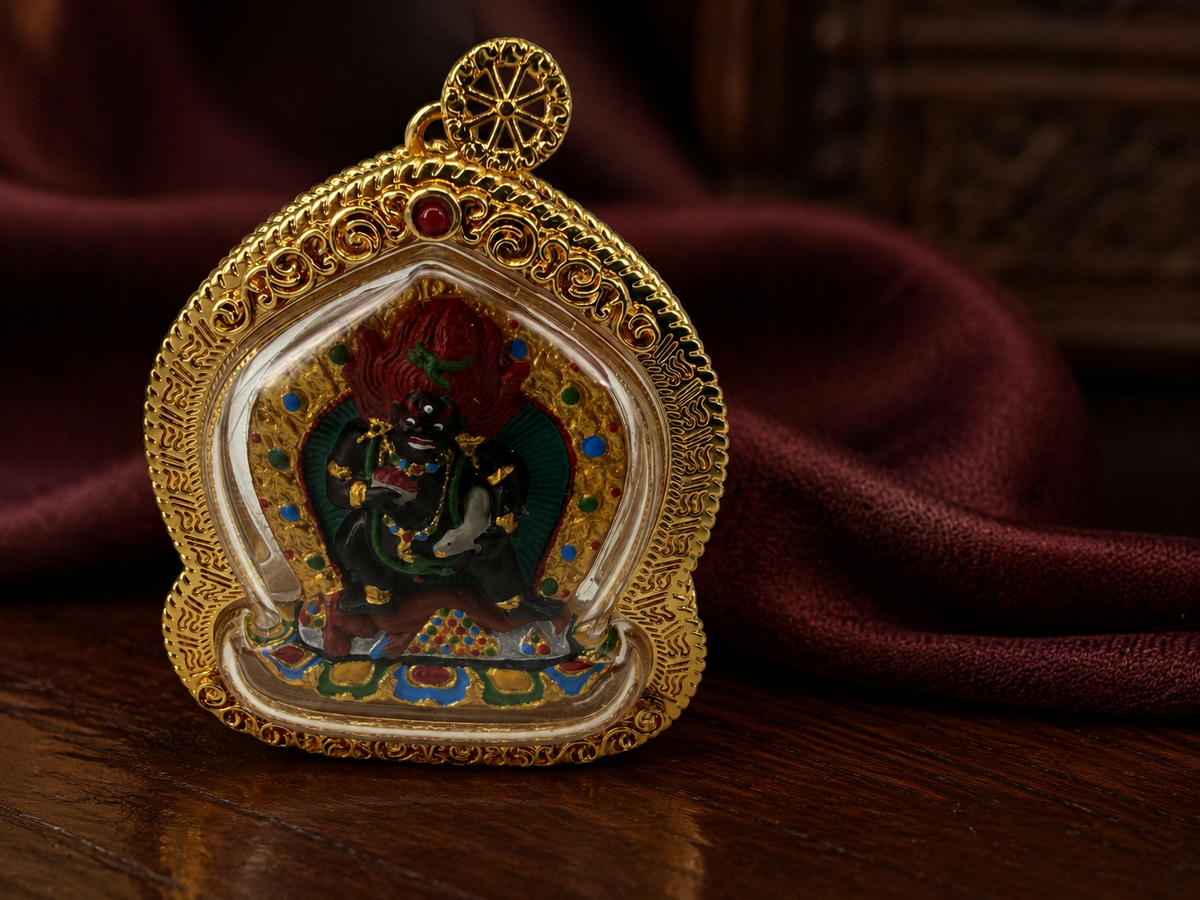
ABSTRACT / DIRECT ANSWER
The animal held by Jambhala—also written Dzambhala in Tibetan contexts—is not a mouse but a mongoose, Sanskrit nakula. In Buddhist wealth-deity imagery, the mongoose becomes one of Jambhala’s most persistent identifying attributes: it may be held in the hand, placed across the knee, or shown disgorging jewels. Historical sculptures from eastern India, western Tibet, central Tibet, and Nepal show both continuity and variation in how this attribute was rendered. The iconographic fact is secure; the explanation is less simple. Connections with older money-bag imagery, snake symbolism, greed, hidden treasure, generosity, and prosperity belong to different scholarly and interpretive layers rather than one universally documented meaning.
Jambhala, Dzambhala, Nakula: The Terms
English-language museum catalogues commonly use Jambhala or occasionally Jambala. In Tibetan and Himalayan contexts, Dzambhala, Dzambala, and related transliterations are also encountered. This article uses Jambhala when discussing museum and Sanskrit-oriented sources, while retaining the Tibetan-context spelling where relevant.
The animal is more straightforward linguistically. Sanskrit nakula means mongoose. Smithsonian cataloguing explicitly associates its Jambhala sculptures with the terms mongoose and Nakula, and the museum describes the animal in its thirteenth-century western Tibetan sculpture as the treasure-bearing mongoose held by Jambhala.
Chinese-language audiences often know the animal as 吐寶鼠, literally “treasure-spitting mouse.” That name is useful as a familiar cultural label, but not as zoological identification. The exact historical route by which this Chinese expression became standard in modern usage is not established by the sources used here. What can be stated securely is that the animal identified in Sanskrit and museum catalogues is a mongoose, not a mouse.
The Mongoose Is Not a Decorative Extra
Jambhala belongs to a much older South Asian family of wealth imagery connected with Kubera, yaksha traditions, treasure, and abundance. By the medieval period, the mongoose had become sufficiently stable that museums now use it as one of the principal identifiers of Jambhala sculpture.
The Smithsonian’s eleventh-century bronze S1992.64, from Bangladesh under the Pala-Sena dynasty, is only 6.7 cm high. Its catalogue keywords include Jambhala, mongoose, Nakula, and snake. The figure is compact, seated, corpulent, and richly adorned; at this scale the animal attribute is small and not easily read in the same way as on later monumental bronzes. The museum’s record nevertheless identifies the mongoose as part of the object’s iconographic field.
Two centuries later, the attribute is far more explicit in the Smithsonian’s western Tibetan S1996.39. This thirteenth-century bronze is 41 cm high—over six times the height of S1992.64. Jambhala sits on a lotus throne, holds a lemon in one hand, and grasps a mongoose in the other. The museum calls the mongoose Nakula and describes it as a receptacle of treasure that spews jewels. The larger scale makes the animal a major visual component rather than a compressed sign.
The continuity is already visible: corpulent wealth deity, seated posture, treasure-bearing animal, and other abundance attributes. What changes is how legible those components become.
Four Jambhalas Across Six Centuries
| Object | Date / Region | Body & Posture | Other Attributes | Mongoose / Jewels |
|---|---|---|---|---|
| Smithsonian S1992.64 | 11th c., Bangladesh, Pala-Sena | Small, corpulent seated bronze | Details compressed by 6.7 cm scale | Museum metadata identifies mongoose / Nakula; jewel flow is not clearly described in catalogue text |
| Smithsonian S1996.39 | 13th c., Western Tibet | Large, relaxed seated figure on lotus | Lemon; foot resting on vessel | Nakula clearly identified; explicitly described as spewing jewels |
| Norton Simon M.1975.14.06.S | Late 13th c., Tibet | Rotund, relaxed seated posture | Partially peeled lemon; rich jewelry; blue lotus garland | Mongoose gripped at neck; three strands of jewels emerge from mouth; neck elongated to make animal visible |
| LACMA M.86.61.3 | Dated 1643, Nepal | Potbellied, crowned, seated in lalitāsana | Citron; princely ornaments; third eye; Newari inscription | “Mythical jewel-spewing mongoose” held in left hand |
What stays remarkably stable?
Across Bangladesh, western Tibet, Tibet more broadly, and Nepal, Jambhala remains associated with a compact or corpulent body, an easeful seated posture, symbols of plenty, and a mongoose.
The citron or lemon appears repeatedly in later Yellow Jambhala forms. The mongoose remains in the opposite hand.
This consistency is also reflected in textual iconographic traditions. Himalayan Art Resources cites descriptions of Yellow Jambhala holding a bijapuraka fruit in the right hand and a mongoose in the left, with jewels falling from it. Such descriptions make the animal part of the deity’s prescribed form rather than an incidental accessory.
What changes?
Scale. The Smithsonian’s eleventh-century eastern South Asian Jambhala is 6.7 cm high; its thirteenth-century western Tibetan example is 41 cm. An attribute that becomes a few millimetres of metal on one object can become a fully modelled animal on another.
Visibility. The Norton Simon sculptor exaggerated the mongoose’s neck so its head could be seen clearly from the front. Iconographic clarity could therefore require anatomical adjustment.
Rendering of treasure. In some objects, the catalogue simply identifies a mongoose. In the Norton Simon sculpture, three individual streams of gems are visible. In the Smithsonian and LACMA examples, the museum descriptions explicitly identify jewel-spewing mongooses even though the jewel flow is rendered differently.
The visual formula persists, but artists adjust it to material, scale, regional style, and compositional need.
When Did the Mongoose Become a Stable Jambhala Attribute?
The selected museum objects show that the association was already established by the eleventh century in eastern South Asian Buddhist sculpture and remained active in Tibetan and Nepalese imagery centuries later. Smithsonian S1992.64 is direct object evidence for an eleventh-century Jambhala from Bangladesh catalogued with Nakula/mongoose imagery.
- That does not establish the first historical appearance of the mongoose.
Earlier South Asian wealth imagery is more complicated.
Alexandra van der Geer’s study of Indian mongoose imagery examines Kubera and Jambhala sculptures from several centuries. Her object comparison suggests a possible progression from a large money bag held in front, to a smaller bag resting across the knee, and eventually to a mongoose resting on the knee or held in the hand. She also cautions that different iconographies could coexist in the same period or region.
This is a scholarly interpretation, not a settled linear evolutionary law.
Van der Geer points to fourth–sixth-century examples in which the wealth deity carries a money bag; sixth–eighth-century forms place the bag more casually over the knee; tenth–twelfth-century images increasingly present an animal identifiable as a mongoose. She also discusses ambiguous examples where the left-hand attribute could plausibly be read either as a bag or a crudely rendered animal.
The mongoose may not simply have “replaced” the bag overnight. The two forms may have overlapped visually and conceptually.
Mongoose or Money Bag?
The connection is strengthened by language.
Sanskrit lexicographical evidence records nakulaka, in some contexts, as a purse or money bag. V. S. Agrawala’s study of obscure words in the Divyāvadāna identifies nakulaka as a money bag or purse, and later Sanskrit dictionaries preserve that lexical possibility.
This does not mean that every sculpted mongoose is “really a purse,” nor does it prove that the animal originated entirely from a misunderstanding of a word.
Van der Geer notes a late-twelfth-century Jambhala from the former Bengal region whose left-hand object is difficult to identify: its position suggests a money bag, but its shape could also be read as a crude mongoose.
Documented fact: both money bags and mongooses occur in South Asian wealth-deity imagery.
Scholarly interpretation: the iconography may have developed through a gradual visual and semantic relationship between purse and animal.
Open question: no single surviving source proves one simple historical moment in which “the purse became the mongoose.”
Why Does the Mongoose Spit Jewels?
By the time the Jambhala mongoose is securely established, jewel production is part of the image itself.
The Smithsonian describes Nakula as a treasure receptacle that spews jewels. Norton Simon records three distinct strands of gems issuing from its mouth. LACMA calls the animal a “jewel-spewing mongoose.” Himalayan iconographic descriptions similarly describe jewels showering from the mongoose held by Yellow Jambhala.
At this level, the evidence is strong: Jambhala + mongoose + jewels is documented iconography.
The image transforms “wealth” into a visible action. Treasure does not merely sit beside the deity; it flows outward. That visual function is more secure than any single later symbolic explanation.
What Does the Mongoose Have to Do with Snakes?
Here the evidence becomes interpretive.
Mongooses are real predators of snakes. Their zoological relationship made them available for symbolic interpretation, but museum explanations do not all develop that symbolism in the same way.
The Norton Simon Museum connects the mongoose with snakes and describes snakes as guardians of the earth’s riches. In that reading, the symbolic chain is mongoose → snake → subterranean treasure.
The Rubin Museum offers another reading. Its Jambhala catalogue describes snakes as symbols of avarice or greed and the mongoose—the snake’s natural enemy—as a symbol of prosperity that overcomes the “poison” of greed. A related Rubin entry interprets jewel-spitting as a reminder of the relationship between receiving and giving.
These interpretations are not identical and should remain distinct.
Documented iconography:
- Jambhala holds a mongoose.
- The mongoose may disgorge jewels.
- Snake imagery has a long association with wealth deities and treasure traditions in South Asia.
Museum / scholarly interpretations include:
- snakes as guardians of hidden or terrestrial riches;
- snakes as greed or avarice;
- mongoose as overcoming greed;
- jewel production as a visual metaphor for generosity, circulation, or prosperity.
No evidence used here establishes one of these interpretations as a universal doctrine shared by every Jambhala lineage.
The Animal Itself May Have Contributed to the Symbol
Van der Geer proposes several additional possibilities rooted in observation of real mongooses.
Some mongoose coats can appear speckled with tawny, golden, or glittering tones. She suggests that this visual quality may have contributed to associations with jewels or gold. She also notes that mongooses protect stored grain indirectly by preying on rodents, giving them a practical relationship with household prosperity.
These are hypotheses, not primary Buddhist doctrinal statements.
Taken together, the iconography may reflect several interacting layers: language, animal behaviour, earlier money-bag imagery, wealth-god traditions, and later ritual or symbolic interpretation.
A Source-Critical Reading of the Four Museum Objects
Smithsonian S1992.64 — Bangladesh, 11th century
At only 6.7 cm high, this is the smallest object in the comparison. Smithsonian metadata explicitly catalogues Jambhala / mongoose / Nakula / snake, but the public object text used here does not describe an individually rendered stream of gems. The mongoose association is documented; the exact jewel-flow rendering is not established by that catalogue text.
Smithsonian S1996.39 — Western Tibet, 13th century
At 41 cm, this bronze allows the animal to become fully legible. Jambhala sits in relaxed royal ease with a lemon; the museum explicitly identifies the animal as Nakula and states that jewels issue from its mouth. Mongoose identity, the Nakula name, and jewel-spitting are all documented in the museum record.
Norton Simon M.1975.14.06.S — Tibet, late 13th century
Here the sculptor solves a visibility problem deliberately. The mongoose’s neck is elongated so its head can be seen from the front, and three streams of jewels emerge from its mouth. The animal is designed as a readable iconographic sign.
LACMA M.86.61.3 — Nepal, dated 1643
This Nepalese Yellow Jambhala is seated in lalitāsana, crowned and princely, with a citron in the right hand and what LACMA explicitly calls a mythical jewel-spewing mongoose in the left. A Newari inscription runs around the base.
Across six centuries, the animal remains. Its physical treatment changes.
Looking at a Jambhala Object Today
Historical bronzes can make the mongoose look obvious because they may stand 20, 40, or more centimetres high. A contemporary TIBETAN SHAMBHALA collection example is dramatically smaller: the confirmed Yellow Jambhala piece is only a little over five centimetres high.
In the available white-background product photography, the full object and framed central image can be seen clearly, while the mongoose’s mouth and any individual jewel streams are too compressed to identify securely at the current viewing scale.
That difference in legibility is itself revealing. A tiny tsa-tsa or pendant can compress an attribute that is fully modelled on a forty-centimetre bronze into only a few millimetres of relief and paint. The Norton Simon bronze solves a similar visibility problem by lengthening the mongoose’s neck; a miniature object has much less physical space available.
Where the animal or jewel stream is not legible, the object is best used to study scale and iconographic compression rather than as proof of a specific micro-detail.
Why the Mongoose Survived So Well as an Iconographic Sign
The mongoose solves several visual problems at once.
It identifies the deity. It makes wealth visible. It creates movement as jewels fall or stream from the mouth. It also distinguishes Jambhala from other crowned, corpulent Buddhist figures whose bodies or seated postures might otherwise look similar.
Textual iconographic compilations reinforce that stability. Benoytosh Bhattacharyya’s The Indian Buddhist Iconography, based substantially on the Sādhanamālā and related tantric ritual texts, treats iconographic attributes as crucial to deity identification; Jambhala appears within this broader system of prescribed colours, postures, implements, and bodily forms.
The mongoose is both distinctive and adaptable. It can be rendered realistically, reduced to a small animal shape, made purse-like, stretched for frontal visibility, or shown releasing one or several streams of jewels. Yet the deity remains readable.
What We Can Say with Confidence
Documented facts:
- Nakula is a mongoose, not a mouse, in the Jambhala museum records examined here.
- Mongoose imagery occurs in Buddhist Jambhala sculpture by at least the eleventh century in eastern South Asia.
- It remains a major attribute in western Tibetan, Tibetan, and Nepalese Jambhala imagery from the thirteenth through seventeenth centuries in the objects compared here.
- Jewel-spitting is explicitly documented in multiple museum objects and iconographic descriptions.
- Money bags also occur in older Kubera/Jambhala imagery.
Scholarly interpretations:
- Van der Geer proposes a possible long-term transition from money bag to mongoose in South Asian wealth-deity imagery, while warning that the iconographies overlap chronologically.
- Lexical evidence for nakulaka as “purse” or “money bag” may be relevant to the relationship between the two attributes.
- Real mongoose behaviour, coat colour, and its role in controlling rodents may have contributed additional associations with wealth or prosperity.
Museum and later interpretations include snakes as guardians of subterranean wealth; snakes as greed and the mongoose as its opponent; and jewel-spitting as a reminder of receiving through giving.
What remains unconfirmed is a single universal origin story for the mongoose, a single universal meaning for the snake–mongoose relationship, an exact first appearance based only on the objects discussed here, or identical rendering of the animal and jewel stream in every Jambhala image.
Related Objects
Small Jambhala works in the TIBETAN SHAMBHALA collection provide a contemporary comparison for how a historically stable attribute can be compressed into an object only a few centimetres high. The relevant comparison is visual and material, not a claim that ownership guarantees wealth or any other result.
Related Reading
Black Jambhala Meaning: How to Read His Symbols
/blogs/journal/black-jambhala-meaning-symbols
References / Source Notes
Smithsonian National Museum of Asian Art. Jambhala, accession S1992.64. Pala-Sena dynasty, 11th century; Bangladesh; bronze; 6.7 × 4.5 cm.
https://asia-archive.si.edu/object/S1992.64/
Smithsonian National Museum of Asian Art. Jambhala, accession S1996.39. Western Tibet, 13th century; bronze with traces of pigment; 41 × 25 × 23 cm.
https://asia-archive.si.edu/object/S1996.39/
Norton Simon Museum. Jambhala, accession M.1975.14.06.S. Tibet, late 13th century; brass and gilt copper with semiprecious stones and pigment; 21 × 15.2 × 12.7 cm.
https://www.nortonsimon.org/art/detail/M.1975.14.06.S/
Los Angeles County Museum of Art. Yellow Jambhala, Buddhist God of Wealth, accession M.86.61.3, dated 1643; Nepal; gilt unalloyed copper with traces of red devotional paint.
https://collections.lacma.org/object/54863
Rubin Museum of Himalayan Art. Jambhala, object C2007.27.3, Nepal, 15th century; and Yellow Jambhala, Tibet, 17th century.
https://rubinmuseum.org/collection/c2007-27-3/
van der Geer, Alexandra A. E. “Herpestes spp., the Indian Mongooses.” In Animals in Stone: Indian Mammals Sculptured Through Time. Brill, 2008. DOI 10.1163/9789047443568_026.
Bhattacharyya, Benoytosh. The Indian Buddhist Iconography: Mainly Based on the Sādhanamālā and Other Cognate Tāntric Texts of Rituals. Oxford University Press, 1924.
Agrawala, V. S. “Some Obscure Words in the Divyāvadāna.” 1966.
Himalayan Art Resources. Yellow Jambhala iconographic records.
https://www.himalayanart.org/items/41042
FAQ
Is the “jewel-spitting mouse” actually a mouse?
No. The animal identified in Sanskrit and museum records is a mongoose, Sanskrit nakula. 吐寶鼠 is best treated as a familiar Chinese conventional name rather than zoological identification.
Why does Jambhala hold a mongoose?
The mongoose became a stable wealth-deity attribute associated with treasure and jewel production. Its deeper historical origin may also relate to earlier money-bag imagery, but that transition is a scholarly reconstruction rather than a single documented origin story.
Why does the mongoose spit jewels?
Jewel production is part of the established Jambhala iconographic convention. Smithsonian, Norton Simon, LACMA, and Himalayan iconographic sources all document the mongoose as producing or releasing jewels.
Does the mongoose mean “overcoming greed”?
That is one documented museum interpretation, especially in Rubin Museum materials. It should not be presented as the only meaning accepted across all Buddhist traditions.
Is every Jambhala mongoose shown the same way?
No. In some sculptures it is small and compressed; in others the animal is fully modelled, its neck exaggerated, or several streams of jewels are made visually explicit. Scale, region, date, and medium all affect how the attribute is rendered.