ABSTRACT / DIRECT ANSWER
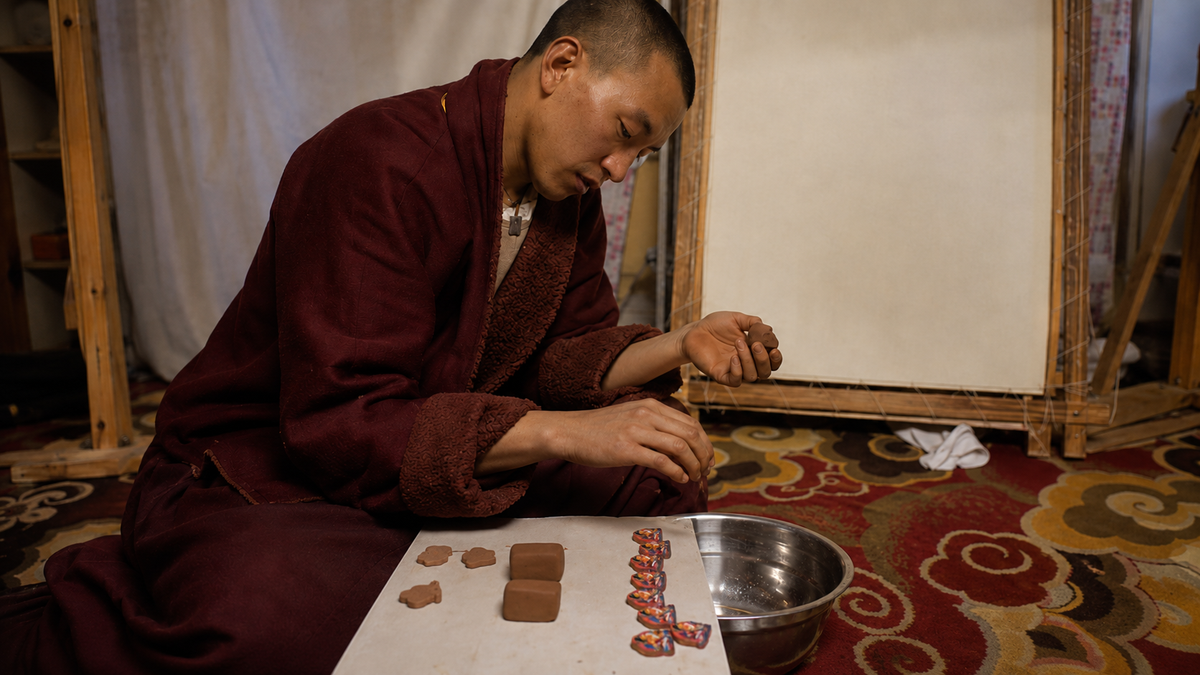
There is no single “traditional Tibetan tsa-tsa process” that applies to every period, region, workshop, or ritual use. Historical evidence shows wet clay stamped or pressed into wooden, metal, and fired-clay molds; objects may be sun-dried or low-temperature fired, left plain or painted, and sometimes mixed with or supplemented by ritually significant materials. What remains remarkably consistent is the importance of the mold. It preserves an image, inscription, proportion, and style so that a sacred form can be reproduced many times. In Tibetan Buddhist practice, this repeatability could serve merit-making, pilgrimage, consecratory deposits, image transmission, and household devotion—not simply manufacturing efficiency.
PART A — HISTORICAL TSA-TSA MAKING
Is There One Traditional Tsa-Tsa Making Process?
No.
Chandra L. Reedy’s materials-and-conservation study describes Tibetan tsha-tshas as clay objects made by stamping or molding wet clay, then either sun-drying or firing it at relatively low temperatures. Paint is frequent, but not universal. Her research also shows that clay recipe, firing, later use, and preservation can differ according to an object’s intended function and history.
Kunsang Namgyal-Lama’s work approaches the same diversity from ritual and art history. Tsha-tshas could be made in large series, but their religious status depended on context, ritual procedure, consecration, and final placement. Some became deposits inside stupas; some were produced in funerary contexts; others circulated as devotional images.
A useful process model is therefore not a single fixed recipe. It is a sequence of possible stages:
material selection → preparation → mold or stamp → forming → release → drying or firing → surface treatment where applicable → ritual completion where applicable → placement, circulation, enshrinement, or use.
Any one object may omit, alter, or complicate several of those stages.
Clay and Other Materials
Clay is the defining material in the historical category, but “clay” was never one chemically identical recipe.
Reedy’s technical investigation found meaningful variation among historical examples. Some sampled objects contained iron-rich clay and sand; others included organic components such as hair or plant fibre. A group of eighteenth-century Tibeto-Chinese examples examined in her study contained fine sand and linen fibres and had been low-temperature fired before receiving painted surface layers.
Historical and ethnographic sources also document the addition of ritually significant substances in some circumstances: earth or sand from sacred places, incense material, ashes or fragments associated with deceased religious figures, barley or wheat, and powdered precious materials. Project Himalayan Art likewise notes documented tsa-tsas incorporating medicinal plants or cremated ashes.
None of those additions is universal.
A tsa-tsa that contains ashes belongs to a particular material and ritual history. A tsa-tsa with grain embedded in its back belongs to another. A plain clay object may still be entirely traditional.
The British Museum’s twentieth-century Prajnaparamita tsa-tsa 2000,1220.3, for example, is molded terracotta with barley seeds embedded in the back. That is a documented object fact, not evidence that barley belongs in every tsa-tsa.
- Material variation can reflect local clay sources, workshop practice, intended durability, ritual purpose, regional custom, and the biography of a specific object.
The Mold: Technology and Religious Infrastructure
A tsa-tsa mold is not merely a shortcut. It is a device for preserving and transmitting an image.
Project Himalayan Art records metal, fired-clay, and wood molds used for small molded Buddhist images. Reedy likewise documents wooden and metal stamps or molds, and notes that fired-clay molds could be used where extensive inscriptions required a complex impression.
The Rubin Museum’s C2006.63.8, a nineteenth-century Himalayan copper-alloy mold for Buddha Amitayus, makes the process physically visible. Measuring approximately 3 7/8 × 3 3/4 × 2 inches, it survives not as a devotional plaque but as the tool that produced devotional plaques.
What can such a matrix preserve?
- the identity of a deity;
- body proportion;
- posture;
- hand gestures;
- ritual implements;
- throne or halo design;
- inscriptions;
- seed syllables or formulas;
- local stylistic habits.
A well-made mold therefore carries both technical information and iconographic authority.
Repeated impressions may come from one matrix, yet each impression can later acquire a different surface, ritual history, owner, place, or function. Historical serial production should therefore be understood within its religious and material context rather than equated automatically with modern anonymous factory replication.
How an Image Becomes Repeatable
Reedy describes two related operations.
Clay may be stamped by pressing a carved form into wet material, or the clay may itself be pressed into a mold and worked until it fills the recesses. Oil could be applied to the clay or mold to improve release and clarity. Excess material could then be trimmed, and faults in the impression corrected by hand.
Early molded plaques sometimes preserve physical evidence of the making process. Reedy notes that some early Indian and Tibetan examples have rounded, convex backs, consistent with a ball of wet clay being stamped while held in the palm rather than placed flat on a table. Such pieces may retain untrimmed edges or fingerprints.
That makes the back of a tsa-tsa technically important. It can preserve evidence of how the clay was supported, whether edges were cut, how deeply the matrix was pressed, whether the object was finished from behind, or whether something was later inserted into the clay.
Pressing, Forming, and Demolding
“Molded tsa-tsa” covers several physical forms.
Some are thin plaques. Others are deep reliefs. Some are miniature stupas in the round. Others approach small three-dimensional sculpture. The mold has to accommodate each geometry differently.
A documented case comes from a modern Monpa tsa-tsa collected by the British Museum at Tawang. The miniature stupa has an extended unmolded section below the image. The museum explains that this projection was used both to pull the object out of the mold and later to stand it upright when offered.
A second Tawang example repeats the same feature: an unmolded tapering portion assists extraction and provides a base for shrine display.
The form solves two practical problems at once: release from the mold and later display.
Historic makers were therefore solving issues of wet-clay strength, pressure, handling, drying, and final use as well as reproducing sacred imagery.
Drying, Firing, and Durability
One persistent oversimplification is that tsa-tsas are always air-dried clay.
Many are. Not all are.
The Metropolitan Museum’s early Tibetan 2011.43, dated to the tenth–eleventh century, is specifically catalogued as sun-dried clay, painted. It depicts a stupa surrounded by the ye dharma creed. Here sun-drying and painted finish clearly coexist.
Reedy, however, documents both sun-dried and low-temperature-fired examples. Her analysis suggests that firing could relate partly to intended use: an object meant for longer-term handling might benefit from firing, whereas tsa-tsas sealed inside stupas or statues, or deposited as offerings, were often left unfired.
Even drying time cannot be turned into a standard rule.
A British Museum tsa-tsa from Tawang is documented as taking about forty days to dry before use at a Losar festival. That figure applies to one documented production context, not to every Tibetan clay object.
Drying or firing can vary with clay composition, thickness, climate, season, form, workshop method, intended handling, and ritual placement.
The answer to “Are tsa-tsas fired?” is therefore: some are; some are not.
Painting and Surface Treatment
Painting is equally variable.
Reedy notes that decorative paint was frequently applied after drying or firing. Her examined eighteenth-century group included reddish low-fired clay with red and gold surface layers; other historical examples use white, green, blue, black, yellow, or orange pigment.
The Met’s 2011.43 proves that an early Tibetan sun-dried tsa-tsa could also be painted.
The Walters Art Museum’s eighteenth-century Tibetan 25.268.2 is made of clay with pigments. Its museum record notes that molded tsa-tsas may be painted, gilded, or left unadorned.
These examples rule out two opposite assumptions: that traditional tsa-tsas were always plain clay, or that they were always fully painted miniatures. Both painted and unpainted traditions are documented.
Four Historical Objects: Mold, Clay, Surface, and Use
| Object | Date / Region | Type & Material | Forming / Surface | Additions / Use |
|---|---|---|---|---|
| Rubin C2006.63.8 | Himalayan Region, ca. 19th c. | Copper-alloy Amitayus tsa-tsa mold | Tool used to transfer a sacred image into clay | Demonstrates reusable matrix technology |
| The Met 2011.43 | Tibet, 10th–11th c. | Sun-dried clay, painted | Molded stupa plaque; painted after formation | Ye dharma inscription; early Tibetan example |
| British Museum 2000,1220.3 | Tibet, 20th c. | Molded terracotta Prajnaparamita | Contemporary impression from a c.18th-century mold | Barley seeds embedded in back |
| Walters 25.268.2 | Tibet, 18th c. | Clay with pigments | Molded and painted plaque | Probably deposited inside stupa or religious building |
Object 1: the mold survives
Rubin C2006.63.8 reverses the normal museum encounter. Instead of seeing the finished devotional object, we see the copper-alloy matrix that made repetition possible. It is a technological object, but it also preserves iconographic information.
Object 2: unfired does not mean unfinished
The Met’s tenth–eleventh-century stupa plaque is sun-dried and painted. Its surface treatment demonstrates that firing and painting are separate decisions. An object can remain unfired yet receive careful finishing and text.
Object 3: the mold can be older than the impression
British Museum 2000,1220.3 was made in twentieth-century Tibet but from a mold dated approximately to the eighteenth century. The object itself also has barley seeds embedded on the reverse.
Three histories intersect: image history, mold history, and impression history. They are not automatically the same date.
Object 4: a refined surface may never have been meant for display
The Walters plaque preserves precise modeling and strong pigment, yet the museum argues that the pair was probably intended for placement inside a stupa or the foundations of a Buddhist building, rather than for ordinary viewing.
A richly finished object, therefore, need not have been made primarily as visible decoration. Its final destination may have been hidden.
What the Four Objects Show Together
Across roughly a millennium, several features remain stable: molded repetition, small scale, Buddhist image or text, and a portable or depositable form.
Other features change substantially.
Material: copper-alloy tool versus sun-dried clay, terracotta, pigmented clay.
Surface: plain matrix, painted clay, embedded additions.
Chronology: the mold and the impression may belong to different centuries.
Function: production tool, devotional plaque, consecratory deposit, contemporary ritual object.
Even mold type cannot always be reconstructed from the finished object alone. The Rubin mold gives direct evidence of copper alloy. Reedy documents wooden and metal stamps and fired-clay molds in the wider historical record. Where the mold material is not documented, the finished object alone may not reveal it.
Why Repetition Had Religious Value
Tsa-tsa production makes sense only when repetition is understood historically.
Kunsang Namgyal-Lama describes tsa-tsas as sacred images produced in large series through molds. In Tibetan religious contexts, the making of images could generate merit, and consecrated tsa-tsas could themselves become deposits placed inside stupas and other sacred structures.
Project Himalayan Art likewise states that molded plaques could be mass-produced and deposited in stupas for the accumulation of religious merit.
- Reedy adds several other functions: pilgrimage images, household devotional objects, portable religious objects, funerary use, consecratory deposits, iconographic reference sets, and the making process itself as religious practice.
“Mass production” in this context does not mean the same thing as a modern industrial commodity line.
Historically, a mold could allow a correct sacred image to be reproduced many times. The repeated image could then travel with pilgrims, enter multiple shrines, fill a stupa, serve as an offering, preserve a deity’s iconographic form, or participate in ritual practice.
Serial production was sometimes part of the religious logic. Efficiency and sacred purpose were not opposites.
What Happened After the Object Was Physically Made?
Physical completion and ritual completion are not the same event.
Namgyal-Lama’s work emphasises consecration as a separate religious process through which produced tsa-tsas could acquire a different sacred status and subsequently function as deposits in other sacred structures.
Reedy likewise records consecratory procedures in which prepared clay, inserted grains or mantra rolls, drying, painting, recitation, and later use could form parts of a larger ritual sequence.
The historical record is diverse. Some documented examples were made for religious practice, some in funerary contexts, some as pilgrimage objects, some as deposits, and some for household shrines.
A useful distinction is therefore:
production — how the physical object was formed;
ritual completion — what religious procedures followed, if any;
placement / use — where the completed object went.
These histories overlap, but they are not interchangeable.
What Varies by Period, Region, and Purpose?
Almost every technical question depends on context.
Clay
Different geological sources produce different texture, colour, shrinkage, and durability.
Additives
Fibres, ashes, grain, medicinal substances, sacred earth, or precious powders occur in documented examples or textual traditions, but none is universal.
Mold
Metal, wood, and fired clay are documented. A surviving object may not reveal which was used.
Form
Plaque, deep relief, miniature stupa, and forms in the round require different handling.
Drying
A forty-day Tawang example is real evidence, not a traditional standard.
Firing
Both unfired and low-fired objects are documented.
Paint
Some remain plain; others are painted, gilded, washed, or otherwise treated.
Ritual use
The physical object alone does not prove the exact blessing, consecration, funerary rite, or pilgrimage history it received.
The historical category is unified by a technology and religious culture, not by one rigid recipe.
PART B — CONTEMPORARY PRACTICE AT TIBETAN SHAMBHALA
TIBETAN SHAMBHALA’s current production methods are contemporary documented cases operating within a much older visual tradition. They should be understood on their own terms rather than used as a universal model for historical tsa-tsa making.
CS SERIES
For the CS Series, the strongest confirmed production fact concerns painting.
Each piece is individually hand-painted by artisans who have undergone years of traditional painting training. Their technical background is close to the disciplined drawing, line, and colour work associated with Tibetan traditional painting and thangka-related craft training.
After completion, CS pieces receive approximately one to three days of prayer and recitation rites.
- The available series-level record does not establish one standard clay recipe, one standard forming technique, one standard mold type, one standard demolding method, or one standard drying duration.
The verified CS process therefore centres on skilled individual hand painting and the documented one-to-three-day prayer / recitation period after completion.
ES SERIES
The ES Series follows a different production route.
Its base form uses a machine-assisted forming / demolding process. Ordinary workshop artisans or workers then complete the objects individually by hand, including visible hand finishing and hand colouring.
After completion, finished ES objects are included together with other devotional objects during a large Buddhist prayer ceremony, where they remain present for collective prayer and recitation.
- The available series-level record does not establish CS-equivalent specialist painting training, an individual one-to-three-day rite for every ES piece, one named monastery or teacher for all ES, or one fixed duration for the collective ceremony.
The documented ES process is therefore: machine-assisted forming + individual hand finishing / painting + collective prayer-ceremony context.
Machine assistance does not make the object culturally meaningless. Historically, tsa-tsa production itself depended on repeatable technologies. The relevant contemporary distinctions are which stages are mechanised, which stages involve handwork, who performs that handwork, and what ritual context is actually documented.
Reading CS and ES as Real Objects
Current product photography provides real-object views for both CS and ES examples.
At small scale, both series show a complete religious image, applied colour, relief or molded structure, and a finished outer form. Some angled views make edges, thickness, and case construction easier to inspect than a frontal photograph alone.
A final object can support direct visual observations about colour placement, edge condition, relief depth where visible, small hand-finished variation, thickness, and surrounding structure.
Other production facts come from workshop and production records rather than from visual inspection of the finished object. Machine-assisted demolding, for example, is a documented process fact; years of artisan painting training are also a production fact rather than something that can be proven solely from one brushstroke in a photograph.
At the current image scale, broad colour, relief, and object structure can be compared. Finer comparison of brushwork, edge treatment, or forming marks requires sufficiently detailed close views of the actual object.
What We Can Say with Confidence
Historical evidence supports the following:
- tsa-tsas were made using repeatable molds or stamps;
- wooden, metal, and fired-clay mold technologies are documented;
- some tsa-tsas were sun-dried, while others were fired at low temperature;
- painting was common but not universal;
- some historical examples incorporated grain, ashes, medicinal substances, fibres, or other additions, but these are context-specific;
- mold-based serial production could serve merit-making, consecratory deposits, pilgrimage, devotion, and iconographic transmission;
- a mold can be centuries older than a later impression made from it.
For TIBETAN SHAMBHALA:
- CS = trained artisan hand painting + approximately 1–3 days prayer / recitation;
- ES = machine-assisted forming/demolding + individual hand finishing/painting + inclusion in a large collective Buddhist prayer ceremony;
- these are separate contemporary processes;
- neither should be treated as the universal historic method.
What Remains Unknown or Object-Specific
The available evidence does not establish one clay formula for all historic tsa-tsas, one mold material for all regions, one drying duration, firing or non-firing as a universal rule, painting as universal, medicinal or funerary additions as universal, one consecration process, or one final use.
- For the current series, the records used here do not establish a single CS forming or demolding method, a single CS drying duration, a fixed ES ceremony duration, or one named temple or officiant for all ES pieces.
Material histories are most accurate when those differences and gaps remain visible rather than being filled with a generic “traditional” process.
Related Objects
For contemporary comparison, readers may explore the CS Series and ES Series.
The useful distinction is not “authentic versus industrial.” It is the documented difference between trained hand painting, hand finishing, machine-assisted forming, and specific ritual contexts.
CS Series — /collections/cs-curated-selection
ES Series — /collections/es-entry-collection
Related Reading
What Is a Tibetan Tsa-Tsa? Meaning, History & How It Is Made
/blogs/journal/what-is-a-tibetan-tsa-tsa
References / Source Notes
Reedy, Chandra L. “Multiple Functions and Multiple Histories of Tibetan Tsha-Tshas (Votive Clay Images).” Studies in Conservation 51, Supplement 2, 2006, 144–150. DOI: 10.1179/sic.2006.51.Supplement-2.144.
https://www.tandfonline.com/doi/abs/10.1179/sic.2006.51.Supplement-2.144
Namgyal-Lama, Kunsang. “Du sacré produit en masse : les tsha tsha du monde tibétain.” Histoire de l’art 73, 2013, 97–104. DOI: 10.3406/hista.2013.3472.
https://www.persee.fr/doc/hista_0992-2059_2013_num_73_1_3472
Namgyal-Lama, Kunsang. Technique, usage et typologie des tsha-tsha dans le monde tibétain. Paris IV / INHA research record.
https://agorha.inha.fr/ark:/54721/cb3dada9-042d-4184-ae90-3a280fc0216e
Berounský, Daniel, and Lubomír Sklenka. “Tibetan Tsha-Tsha.” Annals of the Náprstek Museum 26, 2005.
Saerji. “A Preliminary Study on One Folio of Tibetan Tantric Ritual Text Recently Collected by the National Library of China.” Studies in Chinese Religions 7(2–3), 236–244. DOI: 10.1080/23729988.2021.1942522.
https://www.tandfonline.com/doi/full/10.1080/23729988.2021.1942522
Rubin Museum / Project Himalayan Art, C2006.63.8. Mold for Clay Image (tsatsa) of Buddha Amitayus. Himalayan Region, ca. 19th century; copper alloy; 3 7/8 × 3 3/4 × 2 in.
https://rubinmuseum.org/collection/c2006-63-8/
Project Himalayan Art. Creating in Clay / Materials and Technologies.
https://rubinmuseum.org/projecthimalayanart/themes/art-making/
The Metropolitan Museum of Art, 2011.43. Votive Plaque (Tsa Tsa) Depicting a Stupa. Tibet, 10th–11th century; sun-dried clay, painted; 10.5 × 6.7 × 3.5 cm.
https://www.metmuseum.org/art/collection/search/75354
British Museum, 2000,1220.3. Prajnaparamita tsa-tsa. Tibet, 20th century; molded terracotta; 9 × 7 × 2.5 cm; barley seeds embedded; made using a mold dated approximately to the 18th century.
https://www.britishmuseum.org/collection/object/A_2000-1220-3
Walters Art Museum, 25.268.2. One of a Pair of Votive Plaques. Tibet, 18th century; clay with pigments; 12.5 × 8.4 × 2.5 cm.
https://art.thewalters.org/object/25.268.2/
British Museum, 2003,0702.3 and 2002,0802.1. Modern Monpa tsa-tsas from Tawang.
https://www.britishmuseum.org/collection/object/A_2003-0702-3
FAQ
How are Tibetan tsa-tsas made?
Historically, clay was prepared and stamped or pressed into a reusable mold. The formed piece was released, dried or sometimes low-temperature fired, and could then be painted or otherwise treated. Exact processes vary by period, region, and use.
What are tsa-tsa molds made from?
Historical research documents metal, wood, and fired clay molds or stamps. Surviving nineteenth-century copper-alloy molds are preserved in the Rubin Museum.
Are tsa-tsas fired?
Some are; some are not. The Met preserves a sun-dried painted example, while Reedy documents low-fired historical pieces as well.
Are tsa-tsas handmade?
Many historical tsa-tsas involved manual clay preparation, pressing, trimming, drying, and finishing—but the image itself was designed to be reproduced through a mold. “Handmade” should therefore not imply freehand sculpture of every individual piece.
Are all tsa-tsas painted?
No. Painted, gilded, washed, and unadorned examples are documented.
Why were tsa-tsas made in large numbers?
In some Tibetan Buddhist contexts, repeated production could be part of merit-making and could supply images for stupas, sacred deposits, pilgrimage, offerings, and household devotion.
How are modern tsa-tsas different?
Modern makers may use historical hand methods, contemporary molds, machine-assisted forming, new materials, or mixed production routes. The correct description depends on the actual workshop. TIBETAN SHAMBHALA’s CS and ES series, for example, use different verified modern processes and should not be described interchangeably.