ABSTRACT / DIRECT ANSWER
Black Jambhala—Tibetan dzam bha la nag po—is not best understood as simply “the black version of a wealth god.” In the common two-armed Sarma iconographic type, he is black or blue-black, wrathful, standing, compact and pot-bellied, with a skullcup in the right hand and a jewel-expelling mongoose in the left. A fifteenth–sixteenth-century description attributed to Ngorchen Konchog Lhundrub adds upward-flowing brown hair, exposed fangs, naga ornaments, and a yellow “Lord of Wealth” beneath the extended leg. Black Jambhala is not one completely fixed image across every lineage, so identification requires reading colour, posture, face, implements, mongoose, body type, and underfoot figure together.
What Is Black Jambhala?
Jambhala belongs to a wider Buddhist family of wealth deities. “Black Jambhala” identifies one group within that family, but the label does not refer to a single image reproduced without variation across all Tibetan traditions.
Himalayan Art Resources distinguishes multiple Black Jambhala traditions and types, including Bari Lotsawa and Shakyashri Bhadra transmissions as well as later Nyingma treasure traditions. For the Sarma two-armed type, its summary lists one face, two arms, black colour, standing posture, skullcup, mongoose, and an ithyphallic form.
The Bari connection has support beyond a modern iconography database. The Sakya Tradition identifies Bari Lotsawa Rinchen Dragpa (c. 1040–1111) as a major translator who studied for years in India and compiled a collection of sādhana practices. A translated historical catalogue published by the Khyentse Vision Project explicitly includes yellow and black Jambhala in Bari Lotsawa’s tradition among transmitted wealth-deity practices.
Himalayan Art Resources also records a Shakyashri Bhadra transmission and gives an approximate date around 1209. In the sources used here, that precise Black Jambhala-specific date has not yet been independently corroborated by a second source, so it is best treated as a specialist attribution rather than as an independently established chronological fact.
Black Jambhala is therefore better understood as an iconographic family with recurring features than as one frozen template.
Why “Black”? Colour as Form and Symbol
The first and most secure observation is simple: black or blue-black is a documented feature of the form.
The specialist Black Jambhala page identifies the Sarma form as black, and Ngorchen Konchog Lhundrub’s description, as transmitted by Himalayan Art Resources, explicitly describes the deity’s body as black.
The next step—explaining what black means—requires more restraint.
Within broader Himalayan tantric iconography, specialist resources associate black or blue-black with wrathful activities, protection, and fierce resolve. Project Himalayan Art likewise notes that wrathful imagery commonly uses visual devices such as flaming hair, bulging eyes, fangs, and trampling to mark forceful tantric modes of representation.
This broader colour system provides context rather than one universal definition. Colour operates inside larger ritual and iconographic systems and should be read with posture, implements, lineage, and deity identity.
Documented form feature: Black Jambhala is black or blue-black.
Broader iconographic interpretation: black/blue-black is often associated with wrathful or forceful ritual activity.
Not established: one single symbolic definition explains the colour in every Black Jambhala tradition.
Wrathful Does Not Mean Evil
Black Jambhala belongs to the visual language of wrathful tantric imagery.
That visual language developed across Indo-Tibetan esoteric Buddhist art long before modern viewers encountered it simply as a category of “angry-looking gods.” Robert N. Linrothe’s Ruthless Compassion studies the development of wrathful deity forms through Indian and Tibetan sculpture and textual traditions, treating them as historically structured iconographic types rather than expressions of ordinary anger.
Project Himalayan Art identifies common visual markers of wrathful deities: flaming or upward-moving hair, bulging eyes, exposed fangs, open mouths, skull or bone imagery, forceful postures, and trampling figures. It also distinguishes different religious categories of wrathful beings rather than treating every fierce figure as the same kind of deity.
Wrathful imagery therefore cannot be reduced either to “evil” or to a single blanket meaning such as “compassion.” Its meaning depends on the identity, ritual role, and tradition of the figure.
For Black Jambhala, the wrathful face, body, posture, and ritual implements place the deity in a forceful tantric visual mode rather than the serene mode of a Buddha or the more regal visual language of Yellow Jambhala.
How to Read the Face
Ngorchen Konchog Lhundrub’s specific description gives Black Jambhala brown hair flowing upward, exposed fangs, a compact dwarf-like body, and a rounded belly.
The face is therefore best read as part of a coordinated visual system.
Fangs connect the figure with wrathful iconography.
Upward-moving hair contributes to visual intensity and movement.
Strong eyes or a fixed gaze, where clearly represented, belong to the wider wrathful vocabulary. On small objects, however, the exact form of the eyes, fangs, or individual hair strands may be compressed into only a few ridges of relief or touches of pigment.
A detail that cannot be seen clearly in a miniature photograph should remain visually unresolved rather than being inferred solely from the expected iconographic type.
What Is He Holding?
The right hand: the skullcup
For the specific two-armed form described by Ngorchen Konchog Lhundrub, the right hand holds a blood-filled skullcup. The iconographic description is transmitted through Himalayan Art Resources and paired there with the eighteenth-century Rubin Museum sculpture C2001.10.3 / HAR 65026.
A skullcup—Sanskrit kapāla—belongs to the broader ritual and visual vocabulary of tantric Buddhism. Skull imagery appears in many wrathful or semi-wrathful deity systems.
In this documented Black Jambhala form, the skullcup is a defining right-hand attribute and an especially useful visual distinction from common Yellow Jambhala imagery. Yellow Jambhala is commonly associated with a fruit in the right hand and a mongoose in the left; the Black Jambhala form under discussion replaces the fruit with a skullcup.
The left hand: the mongoose
The left hand retains the mongoose, or Nakula, expelling jewels.
This continuity is crucial. Despite the dark body, wrathful face, skullcup, and standing posture, Black Jambhala still belongs unmistakably to the Jambhala family. The mongoose is therefore the visual bridge between Black Jambhala and the wider Jambhala wealth-deity tradition.
The longer history of Nakula, the money-bag question, jewel streams, and snake symbolism is treated in the companion article Why Does Jambhala Hold a Jewel-Spitting Mongoose?
What Is Happening Under His Feet?
In the Ngorchen Konchog Lhundrub description used by Himalayan Art Resources, Black Jambhala’s extended right leg presses on a yellow “Lord of Wealth,” richly ornamented, lying on his back, with jewels issuing from his mouth.
That identification belongs to this specific textual form.
Later symbolic readings sometimes interpret trampling figures as ego, greed, desire, or obstacles. Those readings should be distinguished from the cited Ngorchen passage, which identifies the figure more specifically as a yellow Lord of Wealth.
Wrathful Himalayan imagery frequently includes trampling or subjugated figures, and broader museum interpretation places such postures within a visual language of overcoming or subduing. The specific identity of the figure beneath Black Jambhala, however, should follow the source attached to the particular form being studied.
Naga Ornaments: A Specific Feature
Ngorchen’s description also states that Black Jambhala is adorned with the eight great nagas.
This is a strong textual feature of that particular iconographic description, but it does not mean that eight serpent forms will be individually legible on every Black Jambhala object. At small scale, snake ornaments may be compressed into bracelets, necklaces, cords, or fine contours; in paintings they may be easier to distinguish by colour.
Where naga ornaments cannot be seen or are not identified in an object record, they remain unconfirmed for that individual work.
Body Type and Posture
Black Jambhala is not rendered like a slender bodhisattva.
The Ngorchen description calls him dwarf-like and pot-bellied. The Sarma summary identifies the form as standing.
The rounded abdomen also connects Black Jambhala visually with the broader history of Jambhala and wealth-deity imagery, where corpulence has long been associated with prosperity or plenitude. The Rubin interpretation of its thirteenth-century Black Jambhala similarly places the broad belly within established Asian visual expressions of prosperity.
The common Yellow and Black Jambhala types nevertheless differ sharply in overall visual character.
Yellow Jambhala: more regal, seated, and easeful; commonly fruit + mongoose.
Black Jambhala: dark, wrathful, standing, compact and forceful; in the specific two-armed form, skullcup + mongoose.
This is a practical visual identification aid rather than a complete theological definition.
Four Black Jambhalas Across Time and Medium
| Object | Date / Region | Medium | Body / Posture | Face / Hair | Right Hand | Left Hand | Underfoot / Other Features |
|---|---|---|---|---|---|---|---|
| Rubin C2002.41.1 / HAR 65174 | Tibet, 13th c. | Metalwork, approx. 22.9 cm high | Catalogued as Black Jambhala, wrathful; early sculptural example | Fierce facial type visible in the museum object; detailed micro-features are not individually enumerated in the public object record | Attribute not separately described on Rubin object page | Mongoose is central to Rubin’s interpretation of this work | Broad belly is explicitly interpreted by Rubin as prosperity imagery |
| Rubin C2002.28.1 / HAR 65158 | Tibet, 16th c. | Bronze, 51.13 cm high | Black Jambhala, wrathful; substantially larger sculptural format | Large scale allows greater articulation, but the public HAR item record does not separately catalogue every facial feature | Not individually described in item record | Not individually described in item record | Demonstrates persistence of the Black Jambhala type at monumental scale |
| Rubin C2001.10.3 / HAR 65026 | Tibet, 18th c. | Bronze | Explicitly tied to the two-armed Black Jambhala textual description | Black body; upward brown hair; bared fangs; dwarf-like, pot-bellied form in the cited Ngorchen description | Blood-filled skullcup | Jewel-expelling mongoose | Eight great nagas; extended leg over yellow Lord of Wealth in the textual description |
| Asian Art Museum B72D60 | Ngor, Tibet, 18th c. | Pigments on cotton | Black Jambhala appears as a secondary wealth deity beneath Kurukulla | Small painted figure; details compressed by hierarchical scale | Skullcup | Gem-spouting mongoose | Stands on a yellow sun disk in the museum label |
What remains stable
- Across sculpture and painting, the deity remains identifiable as Black Jambhala; the visual mode is wrathful; standing posture is characteristic of the common Sarma type; the mongoose remains a highly stable family identifier; and the skullcup is retained where the specific two-armed form is explicitly described.
The Asian Art Museum painting is particularly useful because Black Jambhala appears beside Yellow Jambhala within the same composition. The museum label distinguishes them through their implements: Yellow Jambhala carries a gem and jewel-spouting mongoose; Black Jambhala carries a skullcup and another gem-spouting mongoose.
The pairing shows how two members of the Jambhala family can remain visually related while colour, posture, and the second hand attribute distinguish the forms.
What varies—or cannot always be verified
The 13th-century Rubin sculpture is about 22.9 cm high; the 16th-century bronze reaches 51.13 cm. The painted Black Jambhala in B72D60 is a much smaller subordinate figure inside a large thangka.
Scale affects what remains legible. A naga bracelet, fang, underfoot figure, or jewel stream that can be modelled in metal at fifty centimetres may collapse into a small coloured shape when Black Jambhala occupies only a few centimetres of painted space.
Museum records also differ in descriptive depth. HAR 65026 preserves a detailed iconographic text; 65158 and 65174 primarily supply object classification and metadata. Features documented for one form should not automatically be transferred to another object when its own record does not establish them.
Lineage and Type: Bari Lotsawa, Shakyashri Bhadra, and Ngor
The Bari tradition is the better-supported historical anchor in the sources used here.
Bari Lotsawa’s biography identifies him as an eleventh-century translator who studied in India and brought numerous teachings back to Tibet. The Khyentse Vision translation of a later Sakya transmission catalogue explicitly names yellow and black Jambhala in Bari Lotsawa’s tradition.
Ngorchen Konchog Lhundrub (1497–1557) provides the detailed iconographic description used by Himalayan Art Resources for the black two-armed form: black body, compact belly, upward hair, fangs, naga ornaments, skullcup, mongoose, extended leg, and the yellow Lord of Wealth beneath.
Himalayan Art Resources also distinguishes Black Jambhala, Bari Lotsawa and Black Jambhala, Shakyashri Bhadra as separate topics. Its c.1209 attribution for the Shakyashri Bhadra transmission is a specialist attribution in the source base used here; it has not been independently corroborated in this article by a second Black-Jambhala-specific source.
Lineage therefore matters when reading the image.
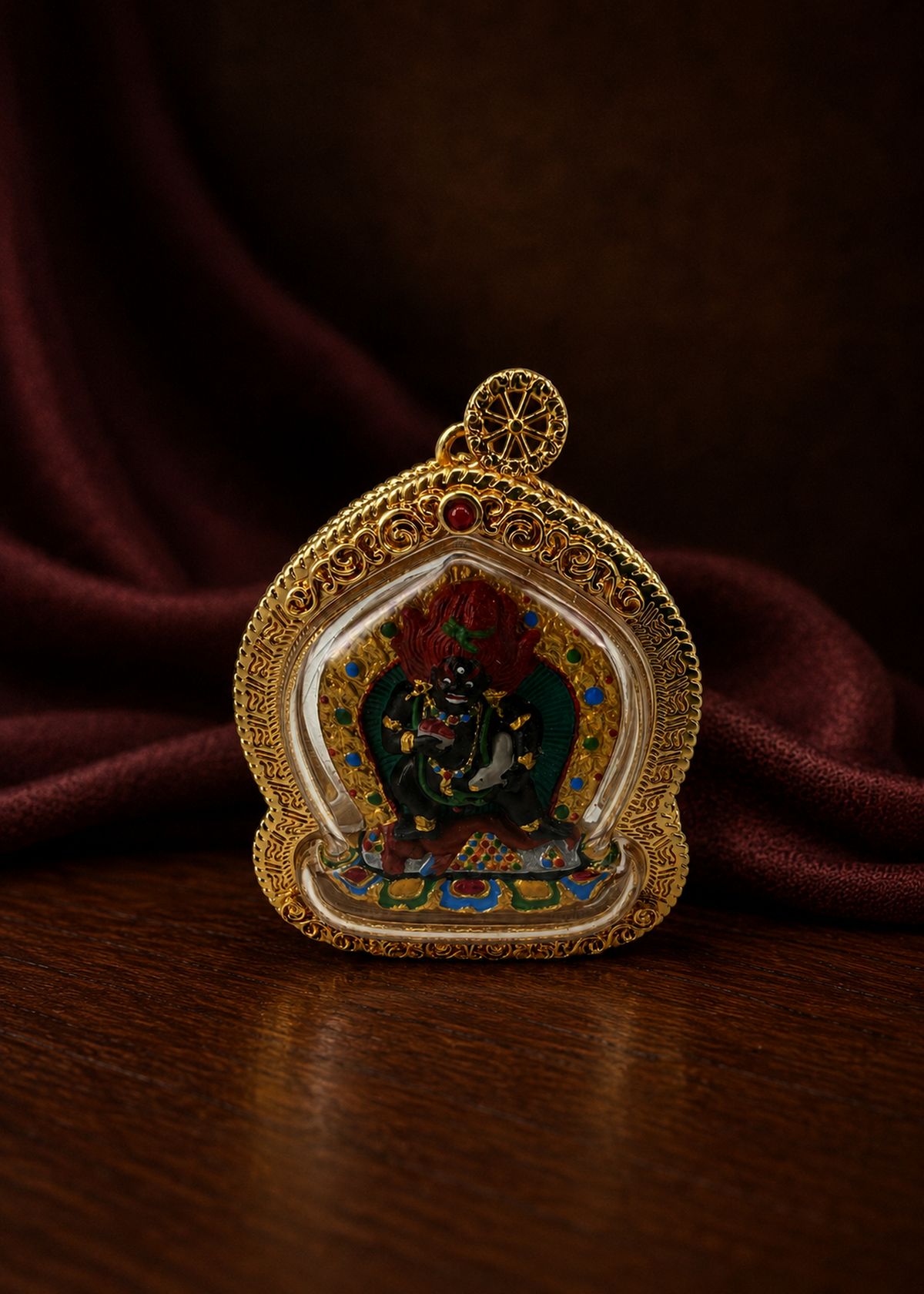
Looking at a Black Jambhala Object Today
TIBETAN SHAMBHALA’s contemporary Black Jambhala objects provide a useful scale comparison with historical sculpture.
In current real-product photography, the central deity is only a few centimetres high inside its protective structure. A dark body and a warmer orange-brown area around the head are visible, while micro-features such as individual fangs, skullcup shape, mongoose, jewel streams, underfoot figure, and naga ornaments are not sufficiently legible at the available viewing scale to be treated as confirmed visual details.
This does not show that those attributes are absent. It shows how severely a miniature object can compress an iconographic system that is explicit on a 20- or 50-centimetre bronze.
The contemporary object is therefore most useful for studying overall colour, scale, and iconographic compression. Fine attributes require a sufficiently detailed close view before they can be identified with confidence.
How to Identify a Black Jambhala Image
1. Check the colour
Is the body black, dark blue, or blue-black? That supports a Black Jambhala identification, but colour alone is insufficient.
2. Check the overall mode
Does the figure appear wrathful rather than serene? Look for some combination of a forceful face, fangs, upward or flaming hair, compact stance, and energetic posture.
3. Check the posture
The common Sarma two-armed form is standing. A dark seated wealth deity may require a different identification.
4. Check the right hand
In the specific two-armed form described by Ngorchen, the right hand holds a skullcup. This is one of the strongest distinctions from common Yellow Jambhala imagery.
5. Check the left hand
Look for the mongoose / Nakula, ideally with visible jewels. Its presence links the wrathful figure back to the wider Jambhala family.
6. Check the body
A compact or dwarf-like body with a rounded belly fits the documented type.
7. Check the feet
If there is a figure beneath the extended leg, identify it from the relevant source rather than assigning a general symbolic label. In the Ngorchen form, the text identifies a yellow Lord of Wealth.
8. Check for naga ornaments
Clearly visible serpent ornaments may support the specific Ngorchen-described type. Where they are not legible, their presence remains unresolved.
9. Check lineage and context
A museum label, inscription, ritual text, or reliable provenance may identify the form more securely than visual resemblance alone.
10. Compare Black and Yellow Jambhala
Yellow: regal/seated, fruit or gem + mongoose.
Black: wrathful/standing, skullcup + mongoose.
The Asian Art Museum’s Ngor painting demonstrates this pairing directly.
What We Can Say with Confidence
- Black Jambhala is not one universally identical image, but the common Sarma two-armed type has a stable cluster of identifying traits: black colour, standing posture, skullcup, mongoose, and wrathful appearance.
- Ngorchen Konchog Lhundrub’s specific description adds dwarf-like proportions, rounded belly, upward brown hair, exposed fangs, eight great nagas, a blood-filled skullcup, jewel-expelling mongoose, and a yellow Lord of Wealth underfoot.
- Bari Lotsawa is a historically documented Sakya translator; later Sakya transmission literature explicitly associates yellow and black Jambhala with his tradition.
- Wrathful imagery belongs to a broad Indo-Tibetan tantric visual vocabulary and should not be reduced to ordinary anger or evil.
- Black or blue-black is a documented form feature; broader symbolic associations with wrathful activity belong to tantric colour interpretation rather than a single universal definition.
- The mongoose remains a key Jambhala-family identifier even when other attributes become wrathful.
- The underfoot yellow Lord of Wealth belongs to the specific Ngorchen textual description; later readings such as “ego” or “greed” are separate interpretations unless supported by a specific source.
- Sculpture and painting preserve the same basic identity while scale and medium alter the visibility of individual details.
What Varies by Tradition
- Not every Black Jambhala lineage necessarily reproduces every feature in Ngorchen’s description.
- Black Jambhala traditions exist beyond the single Bari/Ngor context.
- The c.1209 Shakyashri Bhadra attribution is presently supported here at the specialist-source level rather than by independent corroboration within this article.
- Naga ornaments may be explicit, abbreviated, or visually unreadable.
- The underfoot figure may vary by type.
- Attributes may differ in Nyingma treasure traditions.
- Colour can be altered by pigment loss, metal surface, restoration, photography, or scale.
- Small tsa-tsas can compress or obscure features that are explicit in large sculpture.
- Failure to see a skullcup or mongoose in a low-resolution photograph is not enough to declare the attribute absent.
Related Objects
Black Jambhala works in the TIBETAN SHAMBHALA collection offer a contemporary comparison for how a historically stable iconographic type changes when compressed into a hand-painted object only a few centimetres high. This is a visual and material comparison, not a claim that ownership guarantees wealth, protection, or any other religious outcome.
Related Reading
Why Does Jambhala Hold a Jewel-Spitting Mongoose?
/blogs/journal/jambhala-jewel-spitting-mongoose
References / Source Notes
Linrothe, Robert N. Ruthless Compassion: Wrathful Deities in Early Indo-Tibetan Esoteric Buddhist Art. Serindia Publications / Shambhala, 1999.
Ngorchen Konchog Lhundrub (1497–1557). Black Jambhala iconographic description as transcribed in Himalayan Art Resources, HAR 65026.
https://www.himalayanart.org/items/65026
Himalayan Art Resources. Buddhist Deity: Jambhala (Black) Main Page.
https://www.himalayanart.org/search/set.cfm?page=6&setID=1053
Rubin Museum of Himalayan Art. Black Jambhala, C2002.41.1 / HAR 65174. Tibet, 13th century; metalwork; estimated 22.9 × 11.4 × 8.9 cm.
https://rubinmuseum.org/collection/c2002-41-1/
Himalayan Art Resources / Rubin Museum. Black Jambhala, C2002.28.1 / HAR 65158. Tibet, 16th century; bronze; 51.13 cm high.
https://www.himalayanart.org/items/65158
Rubin Museum / Himalayan Art Resources. Black Jambhala, C2001.10.3 / HAR 65026. Tibet, 18th century; bronze/copper-alloy object.
https://www.himalayanart.org/items/65026
Asian Art Museum. The Buddhist Deity Kurukulla, B72D60. Ngor, Tibet; 1700–1800; colours on cotton; 101.7 × 72 cm.
https://searchcollection.asianart.org/objects/1026/the-buddhist-deity-kurukulla
The Sakya Tradition. “Bari Lotsāwa Rinchen Drag.” Based on An Overview of the Sakya School of Tibetan Buddhism: History, Masters, and Teachings by His Holiness the Sakya Trichen, 2021.
https://sakyatradition.org/biographies/bari-lotsawa-rinchen-drag/
Khyentse Vision Project. The Grove of Wondrous Lotus Flowers.
https://www.khyentsevision.org/static/published-pdfs/B1101_The_Grove_of_Wondrous_Lotus_Flowers.pdf
Project Himalayan Art / Rubin Museum. Wrathful-deity resources and visual-symbol guides.
https://rubinmuseum.org/highlights/wrathful-deities/
FAQ
What does Black Jambhala mean?
Black Jambhala is a wrathful form within the Buddhist Jambhala wealth-deity family. His common two-armed Sarma form combines a black body, standing posture, skullcup, and jewel-expelling mongoose. These are iconographic features, not guarantees of material results.
Why is Black Jambhala black?
Black is a documented feature of the deity’s form. In broader tantric colour systems, black or blue-black is associated with wrathful or forceful activity, but that wider symbolism should not be reduced to one universal explanation for every lineage.
Why does Black Jambhala hold a skullcup?
A specific two-armed form described by Ngorchen Konchog Lhundrub holds a blood-filled skullcup in the right hand. It belongs to the wider ritual vocabulary of wrathful tantric imagery and helps distinguish the form iconographically.
Why does Black Jambhala still hold a mongoose?
Because he remains part of the Jambhala family. The jewel-expelling mongoose is one of the family’s most persistent visual identifiers.
Who is under Black Jambhala’s foot?
In the Ngorchen description used here, the figure is a yellow Lord of Wealth, ornamented and lying supine while jewels issue from his mouth. That identification applies to this specific form.
How can I identify Black Jambhala?
Look for a cluster rather than a single sign: dark body, wrathful appearance, standing posture, skullcup, mongoose, compact pot-bellied body, and—where the specific form applies—an underfoot figure and naga ornaments.